

Offered help recovering broker losses? Check the caller, tracing claims and fees. Use evidence tables to separate promises from authority and actual refunds.

An unexpected message arrives after a disputed broker payment: “We found your money. Pay the release fee and we can return it.” The caller knows your name, the platform and the amount. That familiarity can feel like proof. It is not proof that the caller controls any funds or has authority to return them.
Do not send a new payment or give account access to an unverified person promising recovery. Keep the message, then contact your bank or payment provider through a channel you already trust. This guide helps you separate a recovery claim from evidence and organise the next check without paying to test the promise.
The FCA describes recovery room scams as approaches to people who have lost money through scams or failed investments, offering recovery for an upfront charge. The original operators may contact victims under a different identity, or personal details may pass to another operation. Copied firm names and reference numbers can be part of the approach. The FCA guidance was last updated on 19 January 2026; this is an established pattern, not a claim about a newly discovered firm. FCA: recovery room scams.
The issue is different from an ordinary withdrawal delay. Here, a second party or a new identity is asking you to trust a fresh service or transfer. Keep the original broker dispute and the recovery approach as separate records, even if you suspect they are connected. Record the connection as a suspicion until evidence supports it.
Use three separate questions: Who contacted me? What can they actually do? What am I being asked to hand over? A satisfactory answer to one does not settle the other two.
| What you receive | What it establishes on its own | The missing check |
|---|---|---|
| Your correct loss amount | The sender has that information | How the sender obtained it and whether their identity is genuine |
| A firm name or licence reference | An identifier that can be checked | Whether this contact belongs to that firm and whether its remit fits |
| A transaction map or tracing report | Someone has presented an analysis | Whether its conclusions are reproducible and what action can follow |
| A “funds located” screenshot | A screen contains a number | Who controls the funds and what independently verified process releases them |
| A case number | Someone has supplied a reference | Whether the named institution recognises it through its own contact channel |
This table does not label an unidentified service a scam. It prevents a claim from being promoted into a fact before the relevant check is done. Avoid sending further personal details merely to help an unexpected caller “confirm” information they already claim to possess.
The US Federal Trade Commission warns that lists of people previously targeted by scams may contain names, contact information and payment details. It recommends independently finding an organisation's contact number instead of using the one supplied by the caller. FTC: refund and recovery scams.
For your notes, use two columns: information the sender knew before you replied and information you supplied during the conversation. Otherwise, a later message can make details you disclosed yourself seem like independent inside knowledge. Keep dates and the original messages, not only a summary written from memory.
For cryptocurrency payments, a transaction diagram can look convincing without establishing a route back to your account. The FBI's 11 August 2023 warning distinguishes private tracing claims from seizure authority: private recovery companies cannot issue seizure orders, while exchanges may freeze accounts through internal processes or legal process. The alert also warns about further fee demands after an incomplete or inaccurate tracing report. FBI IC3: cryptocurrency recovery schemes.
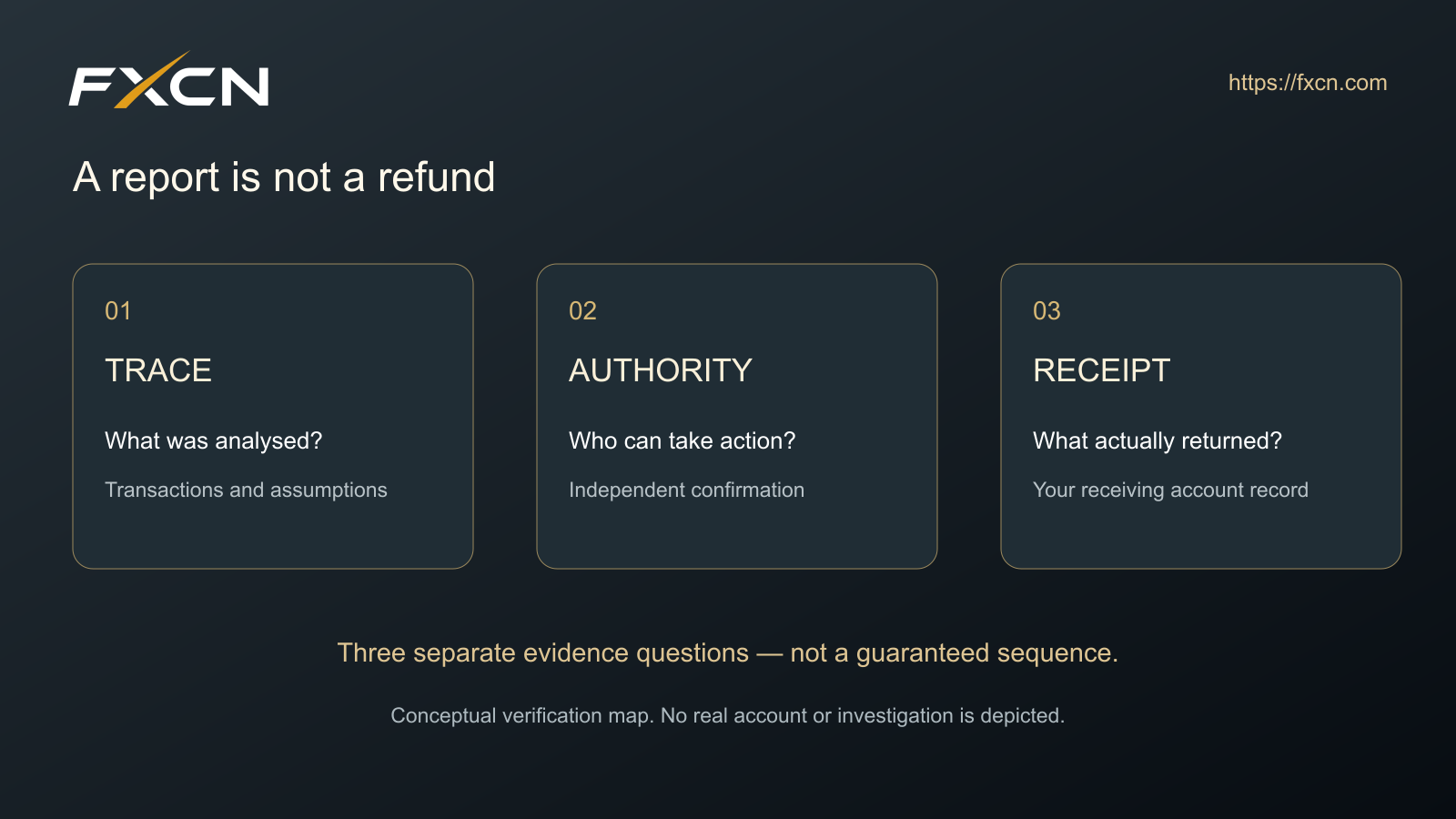
Conceptual evidence map, not a real investigation or a promise that funds can be recovered.
Ask for an explanation of the gap between the report and the claimed result. “Our software found it” is not an answer to “who can authorise a return?” You do not need to resolve a complex legal issue yourself to notice that those are different claims.
| Stage being claimed | A question to record | Do not silently relabel it as |
|---|---|---|
| Trace prepared | Which transaction identifiers and assumptions support it? | Money recovered |
| Institution contacted | Which institution independently acknowledges the contact? | An agreed freeze or refund |
| Action authorised | Who confirms the authority, scope and case reference? | Cash already received |
| Payment returned | What does my own receiving account record show? | Proof that every other claim is genuine |
These are evidence categories, not steps that always occur in order. A provider may dispute the tracing, an institution may decline action, or an applicable process may be unavailable. Do not treat the diagram as a standard recovery timetable.
Scamwatch describes follow-up approaches involving a fee, a percentage of allegedly recoverable funds, tax demands, further investigation payments or requests for remote device access. It advises working with your financial institution and not giving strangers personal information or remote access. Scamwatch: money recovery scams.
Here is a fictional bookkeeping example. It is not a case study, a success-rate estimate or a calculation of legally recoverable damages. A person previously sent £4,000 to an investment platform. A new caller claims £6,200 is ready to be returned and requests successive charges.
| Item | Amount | Paid or only demanded? | Additional cash already sent |
|---|---|---|---|
| Opening “assessment” charge | £180 | Paid | £180 |
| “Release tax” | £620 | Demanded, not paid | £0 |
| “Wallet activation” | £90 | Demanded, not paid | £0 |
| Recovery-stage total | £890 requested | Only £180 paid | £180 |
The next two requests would expose another £620 + £90 = £710. The earlier £180 does not make that new payment necessary or more likely to succeed. The claimed £6,200 is not verified cash and should not be added to the loss ledger. Keep the original £4,000 transfer separate from the later £180 payment so the recipients and events remain clear.
For a real record, add currency, payment date, recipient and transaction reference to each row. Do not combine pounds, dollars and crypto units without recording the conversion basis. Mark a request “unpaid” until your own payment record establishes otherwise. For a fuller complaint pack, use the broker complaint evidence template.
The alternative to an unsolicited recovery offer is not necessarily handling every complex dispute alone. It is choosing and verifying help independently, with a clear scope rather than a guaranteed outcome.
For complaints within its remit, the UK's Financial Ombudsman Service is free for consumers and says you do not need a lawyer or claims management company to represent you. Its process normally starts with a complaint to the financial business, followed by referral when the applicable conditions are met. Check its current eligibility and time-limit guidance; this is not a worldwide refund scheme. Financial Ombudsman Service: how to complain.
A paid engagement you independently seek should still be evaluated. Write down:
These are questions for evaluating a contract, not a finding that a particular fee arrangement is lawful, suitable or fraudulent. If the person claims to be a regulated professional, check the relevant professional body for that role and jurisdiction. A company registration and a financial-services permission are different records. FXCN's official-register verification guide explains that distinction.
Create a new record with the sender's address, claimed organisation, first contact time and exact request. Preserve originals before blocking contact. A short factual timeline is easier to check than a long accusation that assumes the new caller and original platform are the same operator.
Open your bank or payment provider's normal app or use a number from an existing statement. Describe what actually happened, including any payment you authorised under a misleading explanation. Ask what immediate action is available for the specific transfer. Do not wait to finish a perfect document pack before contacting the provider about a recent payment.
The FTC notes that acting promptly may help when seeking to stop or reverse a payment, but recovery is not assured. Its steps after paying a scammer cover different payment methods.
Use this as a note for an independently verified institution or adviser—not as a reason to continue engaging with a suspected scammer:
On [date], [sender] claimed to represent [organisation] and said [amount] could be returned. They requested [payment or access]. I have not independently verified their identity or control of the funds. Please confirm whether you recognise the case and explain the appropriate next step through your official channel.
Replace every bracket with something you know. If you do not know it, write “unknown.” Do not fill gaps with a confident guess.
If you already disclosed credentials or allowed device access, tell the relevant provider exactly what was shared and seek its account-security instructions promptly. Do not send passwords, one-time codes or wallet recovery phrases in a complaint attachment. Use a verified recipient and an appropriate secure channel for sensitive evidence. A public review does not need your full identity documents or bank statement.
A guarantee in a message is not evidence of available assets or authority to return them. Ask what specific work is offered and which outcomes depend on other parties. Do not pay an unexpected caller to test the promise.
No. It identifies a transaction to examine; it does not show that money has returned to you. Keep analysis, authority and receipt as separate evidence questions.
Verify the communication using contact information you obtain independently from that institution. A familiar name or copied reference does not authenticate the sender. Use the clone-domain checklist when the website or contact details do not match.
No such conclusion follows from this guide. The focus is an unverified approach promising recovery, especially when payment or account access is demanded. Independently chosen professional work still needs identity, scope, charges and limits checked.
No. FXCN provides research and verification guidance, not fund recovery, legal representation or a refund guarantee. For an unresolved withdrawal, start with the withdrawal action plan; for other learning resources, return to the learning centre.