

Check what a trading app actually sells: compare fractional shares and CFDs, reconcile a $50 order, and verify custody, fees and transfer terms before buying.

Buying “$50 of a share” and putting down “$50 margin” can look similar on a trading app. They answer different questions. The first describes an investment amount; the second describes collateral for a position. Neither the ticker symbol nor the small entry amount tells you what legal interest you receive.
Start with the product agreement: is this a holding in shares, an interest through a custody arrangement, or a contract that pays a price difference? Then check the records, costs and exit route against that answer. A familiar company name on the order screen is not enough.
ASIC's August 2026 review of nine online brokers examined short-dated options, futures and fractional shares. Its findings included shortcomings in some fractional-share disclosures about rights and costs. The findings were thematic, not a finding that every reviewed firm had every issue. This was an August review, not a new September enforcement action. ASIC's review findings.
For someone comparing a multi-asset broker, the useful question is therefore more specific than “does this app sell stocks?” Ask: what product will this particular order create in my particular account? A broker's share service and its derivatives service should not be treated as interchangeable merely because they share an app.
Moneysmart explains that a CFD gives exposure to an underlying price without ownership of the underlying asset. It is a contract with the provider. Margin can support a larger exposure, and costs can include spreads, commission and overnight financing. Moneysmart: CFDs.
Fractional-share arrangements need a separate check. Moneysmart warns that the structure, rights and costs can differ from ordinary whole-share trading; the label alone does not establish the rights you receive. Moneysmart: fractional share trading.
| Question | Fractional-share arrangement | Share CFD |
|---|---|---|
| What is being described? | Less than one whole share; establish the legal structure | A derivative contract referencing a share price |
| Do I own the underlying share? | Check the agreement and custody records; do not infer from the fraction shown | No underlying share ownership from the CFD itself |
| What should I ask for? | The document defining my interest and who records it | The contract specification and applicable product disclosure |
| What exit question matters? | Can my precise holding move to another provider? | How is the contract closed and its cash balance settled? |
This is a product-identification table, not a recommendation to buy either product. There are separate market, provider and operational risks to assess after identifying what you hold.
There is an important trap in the phrase “the broker holds it for you.” That phrase does not, by itself, prove you have a derivative rather than shares.
The SEC distinguishes registered ownership, where shares are held directly with the company, from beneficial ownership through a bank or broker-dealer, often called holding in street name. This is a US explanation of ownership terminology, not a promise about rights under an Australian or offshore account. SEC: registered and beneficial owners.
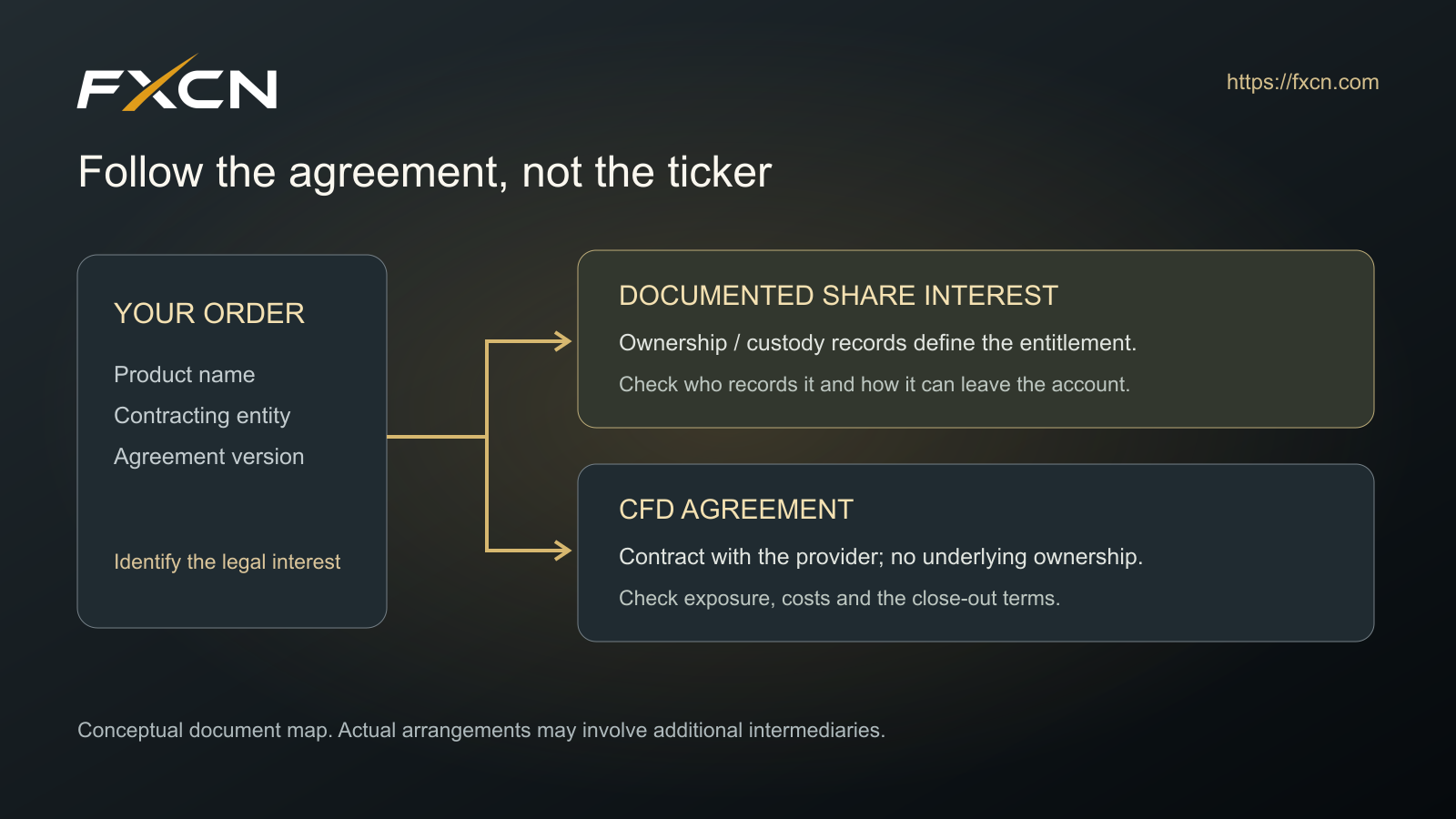
Read the map as a document check, not a diagram of any named broker. Actual custody chains can have additional intermediaries.
Try completing this sentence using the provider's documents, not your assumptions:
My account is with [legal entity]. This order creates [product or interest]. My entitlement is recorded by [entity or system] under [agreement and clause]. To leave, I must [transfer, sell or close] under [exit clause].
If you cannot fill a field, leave it blank and request a written explanation. A blank field is an unanswered question, not evidence of fraud. Save the answer with the agreement version and date so that later changes can be compared.
For the separate identity check, use FXCN's guide to a broker's brand versus its contracting entity. Establishing the entity does not settle the product question; both need an answer.
Here is a hypothetical calculation, not a broker quote. Assume the account and share are both denominated in USD, the share price is exactly $200, and there is no price movement during execution.
If the entire $50 is invested with no fees, the fraction is $50 ÷ $200 = 0.25 share. Now suppose a $1 purchase fee is taken out of that same $50 budget. Only $49 is invested, giving 0.245 share. A rounded display reading “0.25” would not be a sufficient record for reconciling the trade.
| Assumption | No purchase fee | $1 fee deducted from the budget |
|---|---|---|
| Total cash budget | $50.00 | $50.00 |
| Cash used to buy the holding | $50.00 | $49.00 |
| Price per whole share | $200.00 | $200.00 |
| Fraction before platform rounding | 0.250 | 0.245 |
| Value if the share later trades at $220 | $55.00 | $53.90 |
| Change versus original cash budget, before exit costs | +$5.00 | +$3.90 |
The example deliberately excludes tax, dividends, sale fees and currency conversion. It isolates one question: is the amount entered on the screen the invested amount, or the total cash debit including fees? Your actual provider may charge separately rather than deducting the fee. Use the confirmation to find out.
Suppose instead you allocate A$100 to a USD-priced share. Assume an illustrative conversion rate of US$0.65 per A$1 and a separately disclosed 0.5% conversion fee deducted before converting. There are no other fees in this example.
Do not apply this formula blindly if the fee is already embedded in the quoted exchange rate. That would count it twice. Record the rate actually used, the separate fee if any, the final USD amount and the recorded quantity. Reconciliation is more useful than an attractive “commission-free” headline.
Consider a second hypothetical comparison in USD: a fully paid $50 share interest versus a CFD with $50 initial margin and $250 notional exposure. The 5:1 ratio is an arithmetic assumption, not an offered account, a recommended leverage level or a statement of eligibility.
| Price movement | $50 unleveraged exposure | $250 CFD exposure |
|---|---|---|
| Underlying rises 4% | +$2 | +$10 |
| Underlying falls 4% | −$2 | −$10 |
| Loss as a share of the initial $50 cash amount | 4% | 20% |
These are price-only sensitivities. They omit execution differences, financing, fees and any intervening close-out. They do not predict that a live account will remain open through a given price path. The calculation is simply notional exposure × percentage price change. For a fuller explanation, see how to distinguish margin from effective leverage.
The practical lesson is to copy two numbers from the order preview: the total cash required and the notional exposure. If the app shows only one, ask where the other can be found before relying on it for a comparison.
FINRA's US investor guidance highlights limited fractional-share transferability, differences in order aggregation and execution, and broker-dependent voting arrangements. It notes that moving fractional holdings may require selling, with possible fees and tax consequences. Those US observations should prompt questions, not be treated as universal rules for every jurisdiction. FINRA: investing in fractional shares.
Use the following worksheet when asking your current and prospective providers about a move. Request clause references rather than a one-word assurance that transfers are “supported.”
| Question to resolve | Evidence to save | Why a vague answer is insufficient |
|---|---|---|
| Does the receiving account accept this exact product and fraction? | Written acceptance identifying the instrument and quantity | Accepting whole shares does not answer the fractional question |
| If I hold 2.375 shares, what happens to each part? | A breakdown for the 2 whole shares and 0.375 fraction | A single account-level answer may omit the residual holding |
| If a sale is required, who decides its timing? | Order process and any transfer instruction | “We handle it” does not identify the execution instruction |
| What cash remains after the move? | Currency, fees and residual balance treatment | A completed transfer may still leave cash to reconcile |
| How will I retain my history? | Downloaded confirmations and account statements | Access to the old app should not be your only record |
For a dry run, enter a fictional holding such as 2.375 shares into your own notes and ask the providers to describe its treatment. Do not initiate a real sale or transfer merely to test an explanation. If the answers conflict, ask both firms to resolve the specific point before you authorise the move. Obtain tax advice where a disposal could affect your circumstances.
No. The CFD references an underlying price; the contract itself does not make you an owner of the referenced company. Identify the product before drawing conclusions from the ticker displayed.
No. Read the arrangement's definition of your interest, its records and its exit terms. “Fractional” describes a quantity; it is not a complete explanation of the product structure.
Not necessarily. Indirect beneficial ownership and a price-difference contract are distinct concepts. Ask the provider to identify which arrangement applies, rather than trying to decide from the word “custody” alone.
The checks are practical: execution, rights, small-order costs and whether the holding can move. Use the purchase calculation and exit worksheet above to turn those questions into an account-specific comparison.
There is no responsible universal answer for an unknown reader. First establish whether your objective requires ownership or price exposure, then assess affordability, risk and the product terms. A smaller initial cash requirement is not a measure of suitability.
Pause the additional purchase and ask for the relevant agreement clause and a written product description. Keep the response. An unresolved explanation is a reason to investigate further, not a basis for publishing an accusation.
Keep one record containing the order preview, confirmation, governing agreement and the completed ownership sentence. Reconcile the quantity and cash debit using the worked examples, replacing every assumption with the provider's actual figures. Separately verify the broker's licence in its official register; a licence check does not replace reading the product agreement.
This guide explains a verification process, not a recommendation for a security, provider or trading strategy. Australian and US educational sources are identified separately because account rights depend on the applicable agreement and jurisdiction. Continue in the FXCN learning centre.